Publications
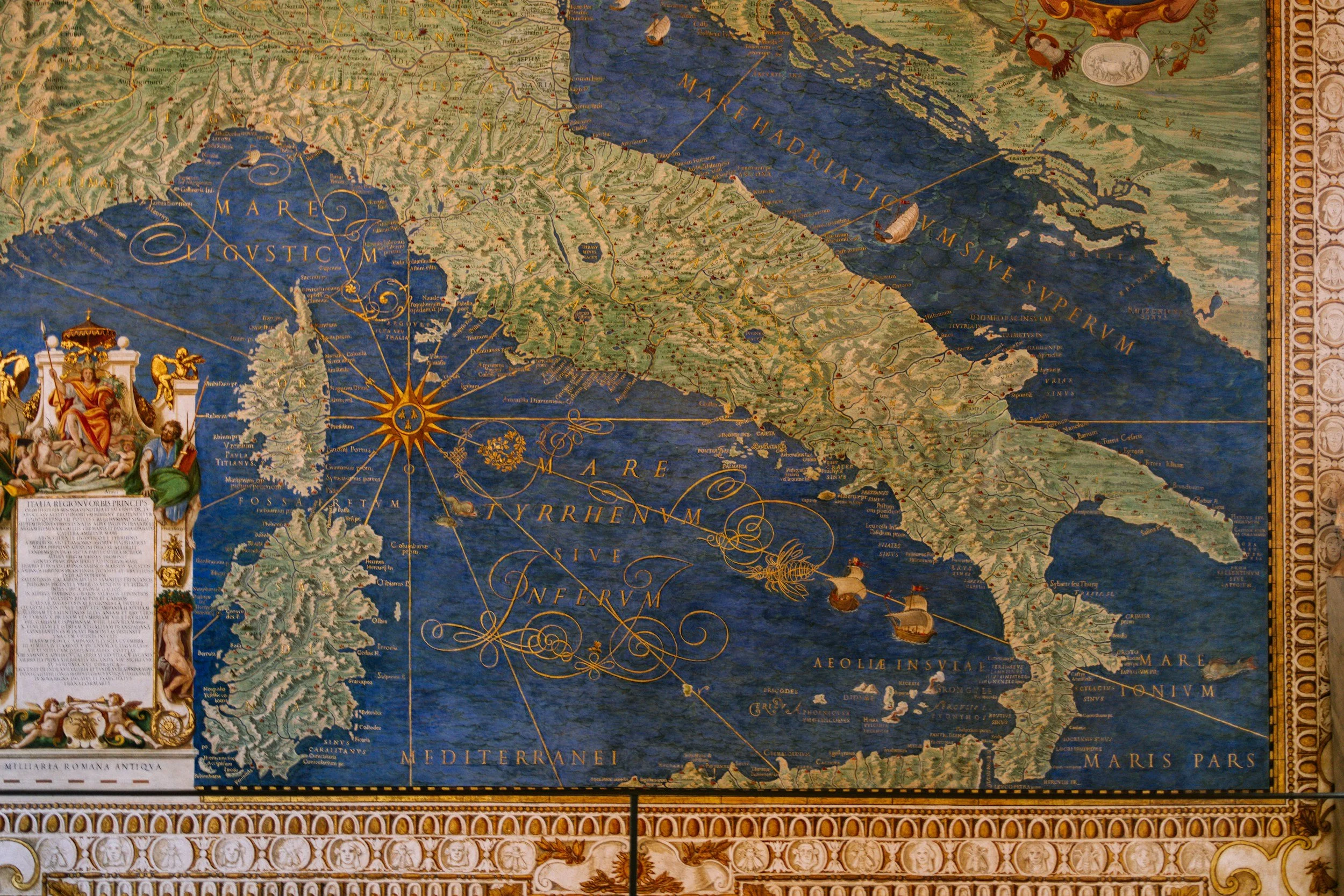
“Seizing the Regno: Relics and the Politics of Aragonese Expansion in the Fifteenth Century Mediterranean”
Forthcoming with History: The Journal of the Historical Association
On 2 June 1442, Alfonso V of Aragon was crowned in the city of Naples as the fleet of the deposed monarch, Renée of Anjou (r. 1435-1442), fled to the shores of Provence. After over twenty-years of warfare between Alfonso and various Angevin rulers since the reign of Johanna II (r. 1416-–1435), Alfonso was now the king of the Regno and the territories of the Kingdom of Sicily. Over the span of his sixteen-year reign, Alfonso used Naples as a tool to build his reputation as a new Roman and Imperial ruler in the Italian south. To explore the role of empire building in Aragonese Naples, this article will focus on Alfonso’s representation as an imperial ruler in his use of relics – particularly the stolen relics of Saint Louis of Toulouse and the Holy Chalice – in Alfonso’s attempts to lay claim to the Italian Regno. Relics were a pivotal piece in Alfonso’s position as a ruler in Naples, Valencia, and across the Mediterranean Sea. This article will suggest that Naples – as well as the full Crown of Aragon – was in the process of building itself as a maritime empire by the mid-fifteenth century, with relics and religious objects being a pivotal piece of this history. In using Alfonso as a guide, this article will consider late medieval conceptions of empire and statehood through the rise of Aragonese rule in the Italian Regno.
“‘Besieged by Such Despair’: La Reyna de Mallorques and the Voices of Imprisoned Medieval Women”
in España en la escena global. Redes de poder, comercio y cultura(siglos XV–XXI)
edited by Marina Perruca Gracia and Javier Rodríguez Abengózar. Forthcoming with Tirant lo Blanch Press
As the dust settled in the aftermath of the Battle of Llucmajor in 1349, Queen Violante of Mallorca was dragged away in chains. Taken by Aragonese forces to nearby Castle de Bellver, the remaining members of the royal family spent the next decade in captivity. This event marked the second time that King Pere IV of Aragon (r. 1336-1387) took royals into his custody, as his sister, Constança of Mallorca, spent the last years of her life imprisoned in Barcelona. Their incarceration allowed Pere to seize, and through them claim, Mallorca and permanently absorb it into the Crown of Aragon. From the hands of these prisoners, one lyric poem that details the emotional toll and trauma of captivity is entitled La Reyna de Mallorques.
Modern scholars disagree about whether the text was authored by either Constança or Violante due to the similarities in both women’s confinement and the ways that the text expresses grief. Reading La Reyna de Mallorques and its textual survival (in the Biblioteca de Catalunya) through the lens of captivity, gives voice to imprisoned women in broader medieval society, particularly those without documentation, while similarly shining light on the role of imprisonment in Iberian culture. This article argues that La Reyna de Mallorques is a pivotal text for understanding both the evolution of prison literature—particularly in lyrical and poetic form—and how, for its possible authors, the poem serves as a record of their experience. For captives—both literary and physical—La Reyna de Mallorques, its afterlives, and its place in the history of the lyric show both its cultural significance in Catalan territories and the ways that literary, lyrical, material, and artistic sources can illuminate the lives of the jailed in the medieval world.
“‘Sickly and Spent': Reassessing the Life and Afterlife of Anne of Great Britain” in Later Stuart Queens, 1600-1735: Religion, Political Culture, and Patronage edited by Eilish Gregory and Michael Questier.
Available via Springer Link or email me for a PDF copy.
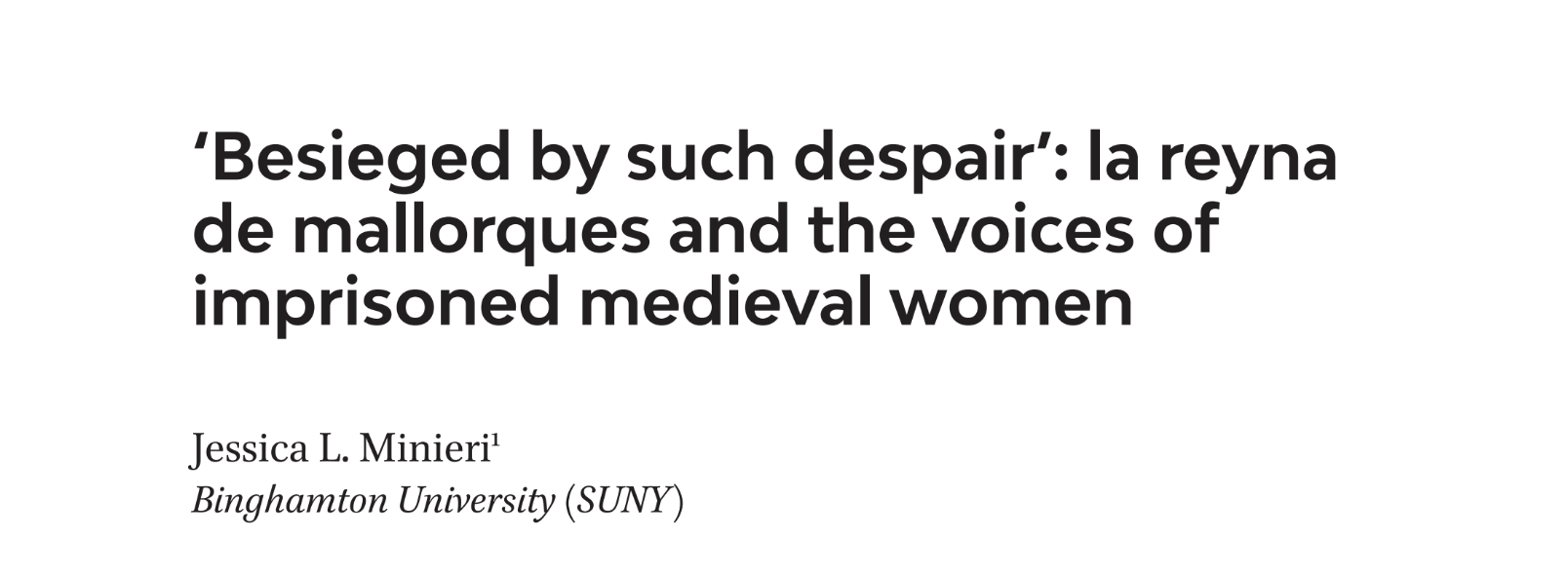
As a reigning queen and historical figure, Queen Anne's memory and reputation have long been shaped by the perspectives of her contemporaries and historians regarding her body and poor health. To understand the ways in which views of Anne's body and health have framed her historical legacy and afterlife, this chapter examines the place of reputation, legacy, and notoriety in the primary documents and early historiography about Anne of Great Britain (r. 1702-1714) in the seventeenth and eighteenth centuries. In the field of queenship studies, especially, Anne’s reign demonstrates how contemporary gossip and historiographical ills affect the long memory of royal women and how those perspectives can hinder their legacy. Despite Anne’s record in European political history in the early eighteenth century, the "failures" of her health, reproductive politics, and court culture have overshadowed how modern audiences and scholars have understood her place in early modern and modern British history. To reposition Anne in early modern studies and understand her reign outside of the challenges of her early historiography, this chapter will argue that Anne -- as a flesh and blood woman and a ruler -- deserves wider examination beyond her "bad" reputation and ailing body


Encyclopedia Articles, Review Articles, and Book Reviews
Encyclopedia Articles:
Contributing Editor, “The Crown of Aragon and Mediterranean Expansion,” forthcoming for the Encyclopedia of the Global Middle Ages with Arc Humanities Press (2024). Available here.
“The Balearic Islands and the Crown of Aragon, 1230–1400,” forthcoming for the Encyclopedia of the Global Middle Ages with Arc Humanities Press (2024). Available here.
“Queenship in Renaissance Sicily” forthcoming for the Routledge Resources Online – The Renaissance World (2026).
Review Articles:
Minieri, Jessica. “Between Freedom and Unfreedom: Imprisonment and Crime in Premodern Europe.” European Review of History: Revue européenne d'histoire 31, no. 3 (2024): 520-525. https://doi.org/10.1080/13507486.2024.2348889. Available via Academia.edu here: https://www.academia.edu/122328871/Between_Freedom_and_Unfreedom_Imprisonment_and_Crime_in_Premodern_Europe
Book Reviews:
Forthcoming:
Tanner, Heather. Lordship and Governance by the Inheriting Countesses of Boulogne (Leeds: Arc Humanities Press, 2023) [Review forthcoming, Medieval Feminist Forum, 2025].
Kelleher, Marie A. The Hungry City: A Year in the Life of Medieval Barcelona (Ithaca: Cornell University Press, 2025) [Review forthcoming, Medieval Feminist Forum, 2025].
Published:
Kagay, Donald and Andrew Villalon, eds., Conflict in Fourteenth Century Iberia: Aragon Vs. Castile and the War of the Two Pedros (Leiden: Brill, 2021). American Academy of Research Historians of Medieval Spain, 2024.
Brolis, Maria Teresa. Stories of Women in the Middle Ages. Montreal: McGill-Queen’s University Press, 2018. Published in Comitatus: A Journal of Medieval and Renaissance Studies (51), 2020
Dodd, Gwilym and Taylor, Craig, ed., Monarchy, State and Political Culture in Late Medieval England: Essays in Honour of W. Mark Ormrod. York: York Medieval Press, 2020. History: Journal of the Historical Association 2021.
Dominguez, Rodrigo da Costa and Amélia Aguiar Andrade, eds., Portugal in a European Context: Essays on Taxation and Fiscal Policies in Late Medieval and Early Modern Western Europe, 1100–1700 (New York: Palgrave Macmillan, 2023) [H-Portugal].
Fleming, Gillian B. Juana I: Legitimacy and Conflict in Sixteenth Century Castile. Cham: Palgrave Macmillan, 2018. Published in Royal Studies Journal, 7(2), 154–155.
Mielke, The Archaeology and Material Culture of Queenship in Medieval Hungary, 1000–1395 (Palgrave Macmillan, 2021). Royal Studies Journal, 9(1), pp.90–91.
Pangonis, Queens of Jerusalem: The Women Who Dared to Rule (Weidenfeld & Nicolson, 2021). Royal Studies Journal, 8(2), pp.226–227.
Sarti, Cathleen. Women and Economic Power in Premodern Royal Courts. Leeds: ARC Humanities Press, 2020. Royal Studies Journal 8(1), 195–196.